

On Wednesday, January 6, in Minneapolis, just over an hour away from where I live, Renee Nicole Good was shot three times and murdered by an ICE agent. The details of why she was there—as a legal observer or trying to return home after dropping her kid off at school—have been debated. It does not matter. There were stuffed animals in her glove compartment. Her dog was in the backseat.
. . .
I have restarted my daily yoga practice. My teacher provides a calendar on which she suggests classes for the day. This month, she is highlighting mantra, and these first ten days have included the Saraswati mantra as an option. It’s a twelve-minute session chanting, “Om aim klim Sarasvatiye namaha.” My teacher is accompanied by a few other people, so it feels like you are within a group when you chant. I have not been much of a mantra practitioner. When I began yoga seriously in 2020, I did not feel comfortable chanting mantra because I didn’t know much about it. While I am not opposed to it on theological grounds, I felt like I was entering murky appropriating territory. As a Catholic, I wanted to be careful: not because I was worried about my own faith, more because I wanted to be respectful of the tradition I was encountering.
Over the years, I’ve learned a bit more and am comfortable chanting. As I became more familiar with mantra, I recognized it’s similarities to my tradition. A mantra often invokes the power or support of a God or Goddess within a particular situation or to impart a certain quality. It is a way of bringing focus to the chanter. The intention behind mantra is reverence, repetition, and humility. You hope to embody that which you intone. Similar things could be said about prayer within the Catholic tradition, especially when you consider our devotion to saints. Within mantra, I recognize the chanting of the psalms in the Liturgy of the Hours or the recitation of rote prayers in the rosary. Relativism? Maybe. I prefer to think of it as an expanded and enveloping view of how divinity shows up in and is reverenced throughout the world.
“Om aim klim Sarasvatiye namaha.” Om, aim, and klim are “bija” or “seed” mantras. Their single-syllable vibrations focus the energy and concentration, connecting practitioners to various elements or deities. Saraswati is the Goddess of wisdom, and namaha can be translated as “may I recognize and honor thee.” As I’ve chanted this mantra this week, I have been attentive to how the Holy Spirit is showing up in and through me. It has not been easy. I have also noticed the way my body and breath change throughout the 108 repetitions: my diaphragm is engaged, and the sound of my voice is deeper and fuller; my hands warm even though I’m not moving; my sinuses clear because of the vibration; my breath may be shallow to begin with, but by the end it has steadied and expanded.
Our Cully dog has been joining me during my yoga practice this week. She likes that she can get attention all to herself. (Lewis is kenneled downstairs while I practice in the guest room upstairs.) I also think she notices the shift in my energy when I settle to the mat. Her own energy shifts too. She starts out insistent about getting pets, but as the mantra proceeds, she softens, lays down, places her head or paw on my crossed legs.
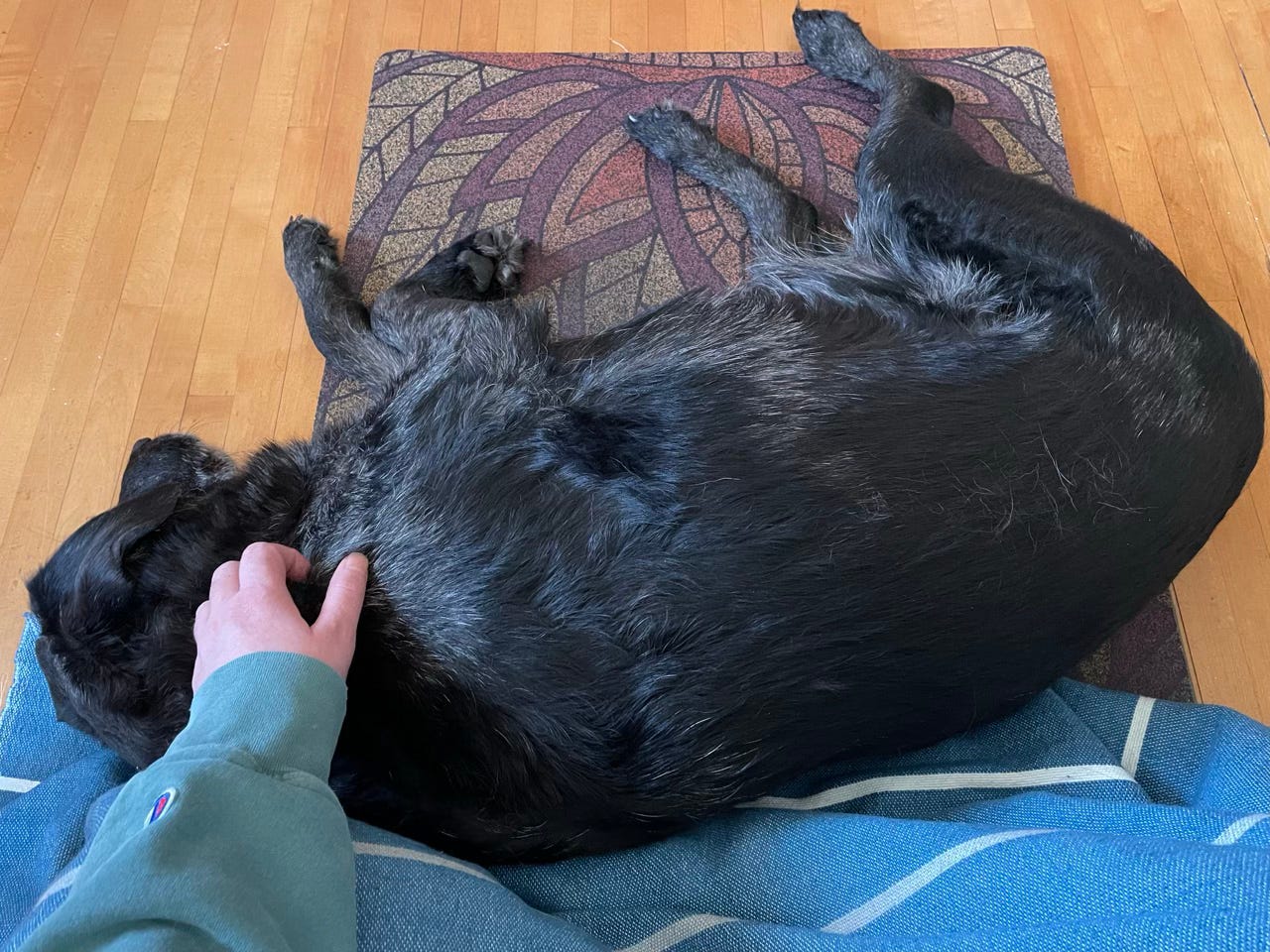
I’ve thought about the Good dog in the car with Renee as Cully practices with me. I’ve thought about the fear that poor puppy felt. I cry.
On Thursday night I texted a friend. We shared the things we’re both doing to stay afloat these days: writing and yoga are our primary methods. But she ended with this: “I WANT LIFE TO BE SOFT.” To that, I said, “I am grateful to have lifelines, but it’d be nice if I could hold them gently instead of with clenched fists and gritted teeth every day.”
. . .
These first days of the new year have been so hard. We are being inundated with violence. We hear about it in the news; we read about it every morning. Even if we are not in the midst of the violence ourselves, we are aware of it. It floods our feeds. I do not watch videos of shootings. When cops murder Black and Brown people, I read the stories, but I will not watch. I did not watch the assassination attempt on Trump or the shooting of Charlie Kirk. I will not put those images in my brain. I saw the video of Renee Good being murdered. I did not want to. The video started as I was scrolling Threads, and I could not get it off my screen fast enough.
Take that in: I, a person who was trying to avoid seeing the video, could not close a browser window or scroll away fast enough to not see a man get out of his car, walk up to a woman turning her car around to escape, and pull the trigger. That’s how fast it happened.
Seconds.
Another image from the video haunts me. One of the men grabbed her door handle and tried to open it. Roughly. No matter what she did, this was not going to end well.
It did not end well.
. . .
As I have come back to my body and breath in a very intentional way, I’ve noticed where, exactly, my body is holding tension. I could have given you very general descriptions of where my tension is: hips, shoulders, jaw. Now I can point to exact spots: my outer right hip; between the lower part of my left shoulder blade and spine; a knot in my left thigh that I tried to work out with a rolling pin; the right side of my jaw, huge knot. I breathe into these spaces throughout the day; I invite softness; I ponder the tension melting away.
My physical reactions to the news this week have fascinated me. I have worked with and managed my anxiety for over fifteen years. I know it well. I saw the video on Wednesday. On Thursday morning, I read Heather Cox Richardson’s letter, in which she details what occurred. My chest and breath tightened; my stomach churned; my head was floofy and light. I kept reading. I have been very aware of the need to release what I’m witnessing from my body. I have also been very aware of the privilege I have to be able to release it. I have suggested to others that they invite softness, that they be gentle, that we seek pockets of peace.
Such comments, though, have felt superficial. What’s happening should cause reaction. I do not want to watch a video of a woman murdered and not feel utter despair. I am full of rage. I should be full of rage. Earlier this week I worried that my desire for gentleness was a way to avoid the realities of what was occurring. But as the days wore on I realized that there is another layer: I do not want to be a hard person because of what our government is doing. I do not want their actions to remove my empathy, to desensitize me, to turn my heart to stone. Hearts of stone don’t beat steadily in moments of calm, flutter in excitement, or skip a beat because they are astounded by what they have just witnessed. Hearts of flesh do. They beat, break, scar, melt. The rage and sadness I feel are not signs of a hardening heart; rather, they indicate that my heart is made of flesh. My call to softness has not been to avoid reality; it has been a refusal to allow the tactics of our government and those who support it to turn me into stone. To make me impermeable and unfeeling.

As I think about what ICE is doing in and to our communities, to our fellow citizens, to those, documented or not, seeking a better life here, of all places, I wonder what it would mean for these agents to invite gentleness. It is, I know, a dream. Everything about those men who encountered Good was aggressive. I have joined the chorus of saying, “Fuck ICE.” But I find myself uncomfortable with that language. Not because I’m a prude but because it feels insufficient. I want this ICE to melt. For the tension and hate and ugliness they have infused into our communities to transform into something different, to wash away, to evaporate. ICE began in 2003 as a reaction to the September 11 attacks. It has never not been a racist agency. We are seeing the logical outcome of an organization created to profile for terrorists based on otherness (read: skin color). ICE’s initial mandate might not have been this, but it was only a hair trigger away. Obviously.
. . .
I have been, on occasion, gasping for breath again. It’s what happens when my anxiety is high. I can’t catch my breath. Because I know this, I am attentive to breathwork to counteract the gasping, to regulate and restore my breath. It evens out eventually.
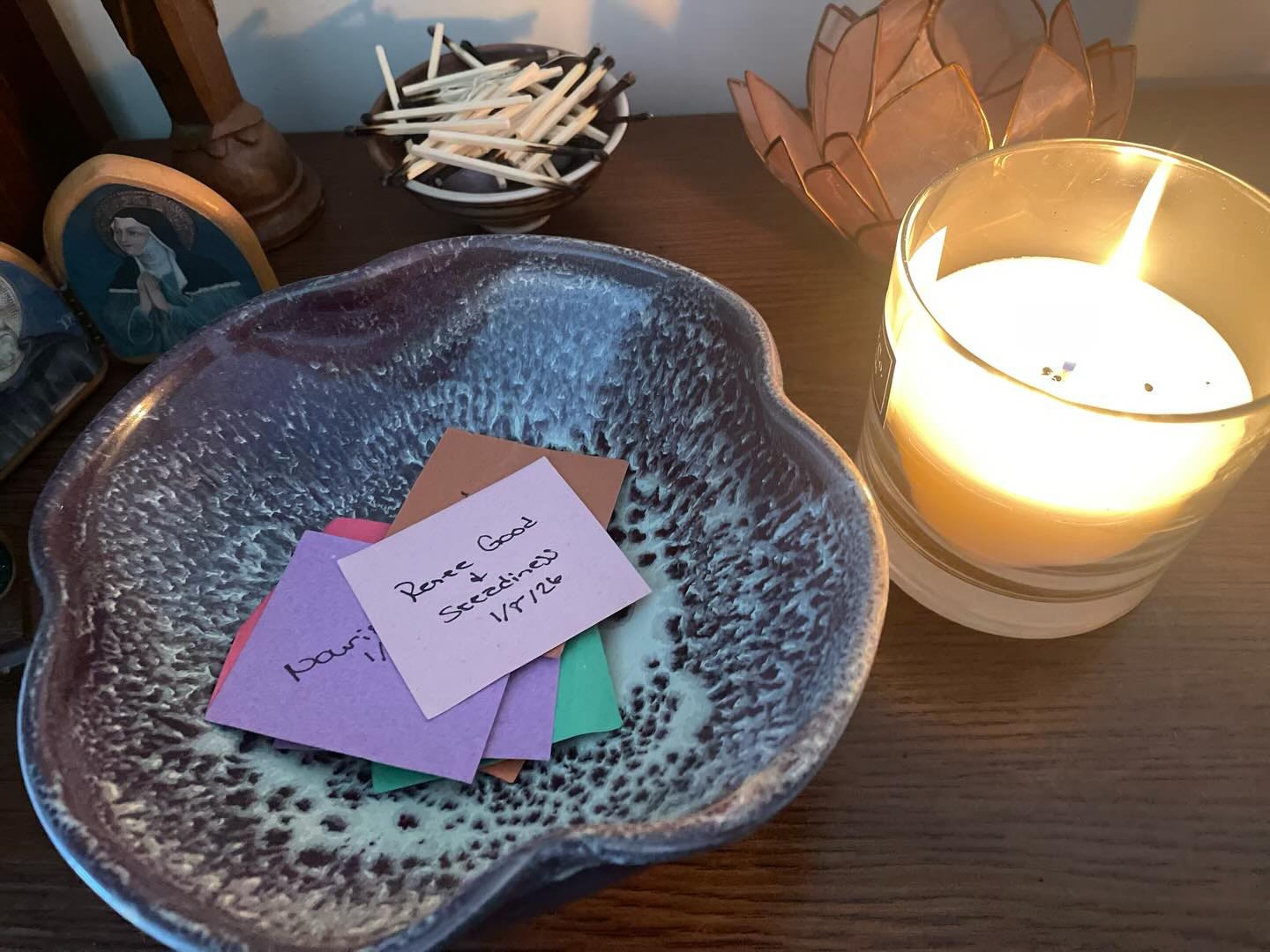
But the catch in my breath this week has been a reminder that some things need to disregulate us. The rug gets pulled out from under us, and we have to find our feet again. It is not easy. It is a privilege to be able to climb back up. It is an honor to have a fleshy heart that stutters because there were stuffed animals in her glovebox and her dog was in the backseat
.
"It is an honor to have a fleshy heart." Thank you for the reminder of this gift today, amidst all that is hard (as ice).